A large number of leaders, directors and owners are racing to adopt AI. Somebody shows a demo, the team gets excited, and a subscription gets bought. But as I said in a recent live session, AI decisions are big decisions. They will shape your business for 5, 10, 20 years, the way the internet reshaped whole industries. And your name is on the decision.
So the real question is not “can we afford to start?” It is “can we afford to finish?”
The Statue of Liberty almost had nowhere to stand
The statue itself was a gift from France. The pedestal it stands on was America’s job, and in 1884, halfway through construction, the money ran out. Everyone wanted the project finished. Nobody knew how to fund it.
Joseph Pulitzer, publisher of the New York World, launched a public appeal on 16 March 1885. He promised to print the name of every donor in his newspaper, however small the gift. By 11 August 1885, about five months later, more than 120,000 people had given over $100,000, most of them about a dollar or less. The pedestal was finished in April 1886, and the statue was dedicated that October.
The lesson for your AI project is not to crowdfund it. It is to understand what it takes to complete the project, and what resources you already have, before you start. As I put it: there is no point having more and more AI demos, getting excited, and producing no results. That is just spinning the wheel.
I just don’t want to get into an engagement and not see it all the way through.
That CEO had 20 years of experience. He knew that once you go down this path it is not easy to undo it. Your sales, operations and decision-making processes start to change around the new technology. He wanted to know the endpoint before he took the first step. That is the right instinct.
How much does AI implementation cost?
Think of AI spending in three levels. Most small and mid-sized businesses should start at level one and earn their way up.
| Level | What it means | Typical cost |
|---|---|---|
| 1. Subscribe | Off-the-shelf AI tools for your team: ChatGPT Business, Microsoft 365 Copilot, Google Gemini | About US$7–30 per user per month, plus your team’s time |
| 2. Connect | AI connected to your own data and systems (CRM, accounting, documents), often with a private AI layer | A defined project, plus ongoing usage and support |
| 3. Build | Custom applications, fine-tuned or purpose-built models | Gartner: from about $750,000 to $20 million upfront at enterprise scale |
For larger organizations, Gartner has published its estimates per deployment approach:
| Approach (Gartner) | Upfront cost | Recurring cost per user per year |
|---|---|---|
| Consume commercial GenAI apps | ~$100K–$200K | ~$280–$550 |
| Embed GenAI APIs in custom apps | ~$750K–$1M | ~$790–$1.2K |
| Extend models with your data (retrieval) | ~$750K–$1M | ~$1.3K–$11K |
| Customize (fine-tuning) | ~$5M–$6.5M | ~$8K–$11K |
| Build custom models | ~$8M–$20M | ~$11K–$21K |
Source: Gartner, July 2024. Figures in US dollars, for enterprise deployments.
The good news: you do not need a large sum to begin. You can start with as small an investment as you need to test the waters, then scale what works.
AI licence prices in the US, Canada and Europe (November 2026)
| Tool | US | Canada | EU (excl. VAT) |
|---|---|---|---|
| ChatGPT Business, standard seat | $20/user/month annual, $25 monthly | Varies by currency | Varies by currency |
| Microsoft 365 Copilot Business add-on | $21 list (first-year promo $18) | CAD $28.50 list | €18.20 list |
| Microsoft 365 Copilot (enterprise add-on) | $30 | CAD $40.70 | €26.00 |
| Google Workspace with Gemini included | $7 / $14 / $22 (Starter, Standard, Plus) | Varies by currency | Varies by currency |
Prices are annual-commitment list prices from each vendor’s site and change often. Both ChatGPT Business and Copilot now bill extra usage beyond included limits, so budget for usage as well as seats.
The costs that don’t show up on the quote
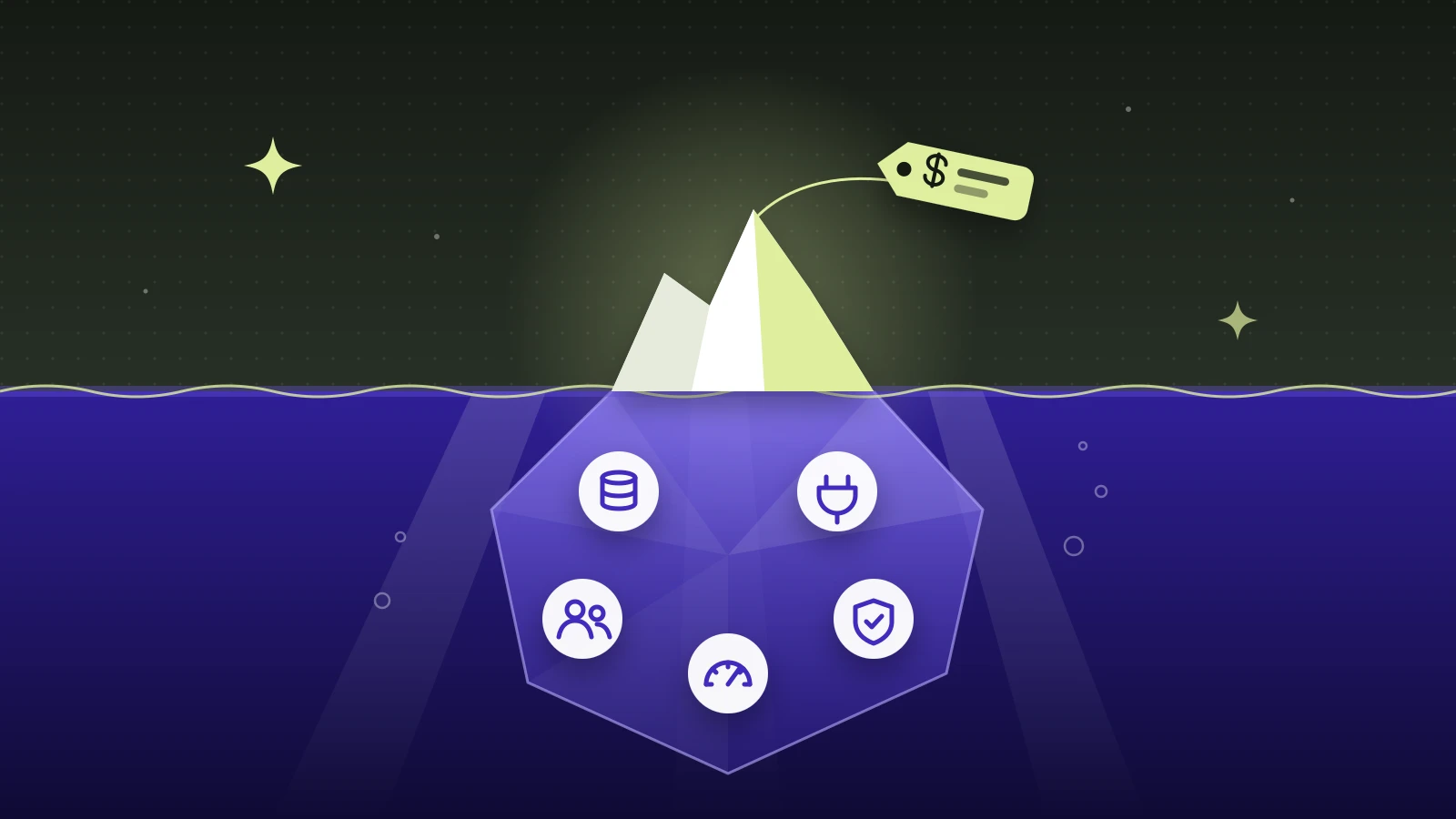
Just budgeting for a Claude or ChatGPT subscription is not enough. The licence is the visible tip. What sits underneath decides whether the project ever delivers.
- Data preparation. In a 2026 Fivetran survey of 500 IT and data leaders, 39% of companies said they spend at least a quarter of their AI budget fixing data problems, and 66% needed more data work than planned. (Fivetran sells data tools, so read it as vendor research, but the pattern matches what we see.)
- Connecting your systems. Bain’s 2026 survey of 951 companies found data access and integration was the number one barrier to AI results, cited by 41%.
- People and change. BCG found that leading companies put about 10% of their AI effort into algorithms, 20% into data and technology, and 70% into people, processes and culture.
- Your team’s capacity. If AI starts creating more work, and your people are already at capacity, who handles it? If team members are fearful of AI, that is the first problem to solve, before any tool.
- Ongoing operations. Subscriptions, platform fees, tokens, monitoring, security reviews and updates as models change.
Why so many AI projects never finish
The research is blunt.
- of generative AI projects predicted to be abandoned after proof of concept by end of 2025 (Gartner)
- 30%+
- of AI projects without AI-ready data predicted to be abandoned through 2026 (Gartner)
- 60%
- of agentic AI projects predicted to be cancelled by end of 2027 (Gartner)
- 40%+
MIT’s 2025 GenAI Divide report went further. It said 95% of organizations it studied were getting zero return from task-specific generative AI tools, with only 5% of integrated pilots extracting real value. Treat that number with care: it is based on 52 interviews, 153 survey responses and a review of public initiatives, and it measured success as reaching deployment with measurable KPIs within six months. But the direction is clear. Most projects stall between the demo and the result.
The reasons Gartner gives are always the same four: poor data quality, inadequate risk controls, escalating costs and unclear business value. Every one of them is a planning problem, not a technology problem.
Five questions to ask before you commit your money and your team
- What business result are we buying? Not “AI”, but a number: response time, conversion rate, hours saved, errors avoided. What is the return on the investment?
- What does our team have to contribute? Money, time, energy, data, training hours. Be specific about who and how much.
- Once it is running, what does it cost to operate? Subscriptions, platform fees, tokens, support, monitoring.
- Who owns the intellectual property, and how will we get support? Including the prompts, workflows and data your team creates. (We wrote about who owns your AI knowledge separately.)
- How will we manage change? If we need to speed up, slow down or stop, how does that happen, and what does it cost?
You can even use AI itself to stress-test your answers. Ask it to question your assumptions, Socratic-style, before a vendor does.
Start small: a bounded first project
Take one burning problem. Maybe too many leads that do not convert. Maybe too many complaints about delivery. Maybe a team that is never on the same page. Take a small piece of it and design a specific test.
- Day 0: record the KPI as it stands today.
- Day 30: first reading. Is the needle moving?
- Day 60: adjust what is not working.
- Day 90: decide, with evidence, whether to stop, adjust or scale your investment.
That is what we did with the franchise group. They had a huge list of problems they wanted AI to tackle. We picked the top three that would affect their bottom line right away, built a short roadmap, and gave each one a specific duration and cost. The CEO got what he asked for: a defined endpoint.
My advice: don’t look at this as an enormous project that puts pressure on everyone. Take small steps on a guided path with a specific outcome in sight.
Funding and support in Canada, the EU and the US
- Canada. The federal Regional Artificial Intelligence Initiative was expanded in October 2026 to $700 million in total, delivered through regional development agencies, to help SMEs adopt AI. Canada’s national AI strategy, launched in June 2026, says only about 8% of Canadian SMEs have adopted AI and aims to lift business adoption to 60% by 2034. Your NRC IRAP advisor can tell you which programs are open now.
- European Union. European Digital Innovation Hubs are being refocused as AI help desks for SMEs, including advice on the AI Act, and the EU’s 2025 Apply AI Strategy commits around €1 billion to adoption.
- United States. There is no dedicated SBA grant for AI adoption, but the SBA offers free counselling, webinars and a small-business AI guide whose advice matches ours: start small.
A simple AI budget worksheet
Before you sign anything, put a number, even a rough one, next to each line:
- Licences or subscriptions, per user per month
- Usage and token fees beyond included limits
- Data clean-up and preparation
- Connecting to existing systems
- Security, privacy and compliance review
- Training and change management
- Internal staff time during the pilot
- Ongoing support, monitoring and updates
- Exit costs: export, migration, switching
If the lines below “licences” are blank, you are not ready to commit, but you are ready for a bounded pilot.
The decision you can make this week
List the major problems in your business. Rank them by how much they would move the needle. Pick the top two or three at most, and run a controlled experiment on the first one.
If you want an experienced partner to scope that first project, with a defined cost and a defined end, tell us your goal. You can also see how we work or read about keeping company data safe in AI tools.
Sources
- National Park Service, Joseph Pulitzer and the Statue of Liberty and Pulitzer in depth; Statue of Liberty–Ellis Island Foundation, overview and history
- Gartner, 30% of generative AI projects will be abandoned after proof of concept, July 2024; lack of AI-ready data, February 2025; over 40% of agentic AI projects will be cancelled, June 2025
- MIT NANDA, The GenAI Divide: State of AI in Business 2025 (archived copy), July 2025
- OpenAI, ChatGPT Business pricing; Microsoft, Microsoft 365 Copilot Business and enterprise; Google, Workspace pricing
- Fivetran survey via TMCnet, November 2026; Bain, Your AI budget is growing, your returns aren’t, June 2026; BCG, Closing the AI impact gap, January 2025
- Government of Canada, Regional Artificial Intelligence Initiative and Canada’s National AI Strategy; European Commission, Apply AI Strategy; US SBA, AI for small business

Questions people ask
How much does AI implementation cost?
It ranges widely. Adding off-the-shelf AI tools costs roughly US$7 to US$30 per user per month in licences: Google Workspace with Gemini starts at $7, ChatGPT Business at $20 and Microsoft 365 Copilot Business lists at $21 on annual plans. For larger deployments, Gartner estimates upfront costs of about $100,000 to $200,000 to roll out commercial generative AI apps, $750,000 to $1 million to embed AI into custom applications, and $5 million to $20 million to fine-tune or build models. The licence is usually the smallest part of the total.
How much does AI cost for a small business?
A small business can start with a few hundred dollars a month in subscriptions for a small team. The larger costs are people's time, cleaning up and connecting data, training staff, and ongoing usage fees. The safest way to control the budget is a bounded pilot: one problem, one KPI and a fixed 30 to 90 day window, before committing to anything larger.
What are the hidden costs of AI implementation?
The most common are data preparation, connecting AI to existing systems, staff training and change management, usage or token fees beyond included limits, security and governance, and ongoing support. In a 2026 Fivetran survey, 39% of companies said they spend at least a quarter of their AI budget fixing data problems.
Why do so many AI projects fail?
Gartner predicted that at least 30% of generative AI projects would be abandoned after proof of concept by the end of 2025, citing poor data quality, inadequate risk controls, escalating costs and unclear business value. Most failures come from starting without a defined outcome, data that is not ready, and a team that does not have the capacity or buy-in to adopt the new way of working.
Is there government funding for AI adoption?
In Canada, the Regional Artificial Intelligence Initiative funds SME AI adoption through regional development agencies, and NRC IRAP advisors can point to current programs. In the EU, European Digital Innovation Hubs offer SMEs AI support, including AI Act advice. In the US there is no dedicated SBA AI grant, but the SBA offers free counselling and guidance.